
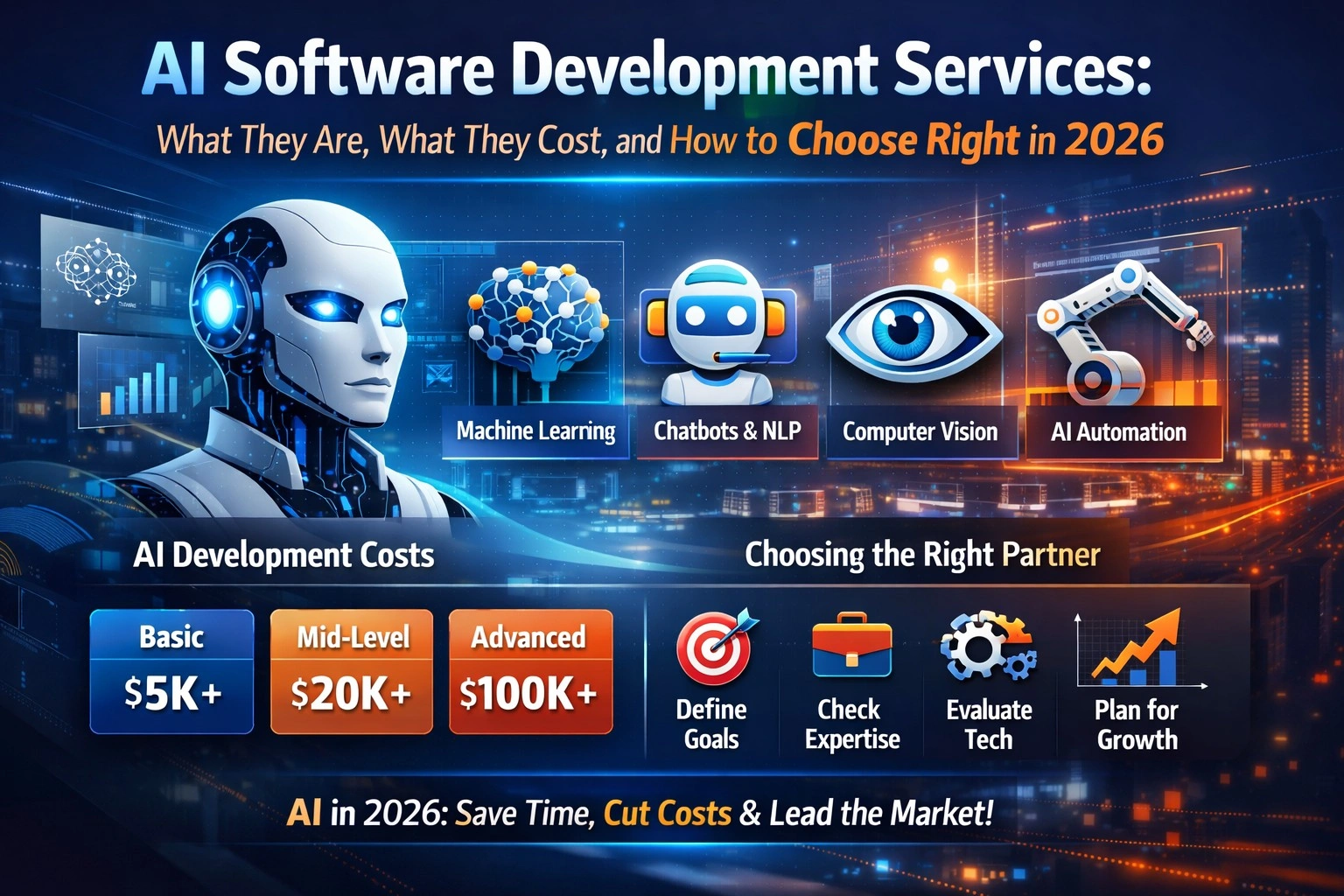
AI Software Development Services: What They Are, What They Cost, and How to Choose Right in 2026

The demand for AI software development services has reached a tipping point in 2026. What was once reserved for well-funded enterprises and research institutions is now accessible to startups, mid-market companies, and growing businesses across every industry. The question is no longer whether to invest in AI; it is how to do it in a way that delivers real, measurable returns.
This guide breaks down exactly what AI software development services cover, how the engagement process works, what drives cost, and what separates a capable AI development partner from one that will cost you time and money without delivering results.
What Are AI Software Development Services?
At the most basic level, AI software development services cover the full process of designing, building, training, deploying, and maintaining software that runs on artificial intelligence.
That covers quite a wide range of things in practice:
- Custom AI applications built from scratch for a specific business problem
- Machine learning models trained on your data that improve over time
- Natural language processing systems that understand and generate human language
- Computer vision tools that analyze images and video
- Generative AI integration using models like GPT, Claude, or Gemini
- Intelligent automation that replaces or supports manual decision-making
- AI capabilities added to systems you already use like your CRM, ERP, or customer platform
The keyword throughout all of this is custom. Off-the-shelf AI tools handle a lot of common use cases well. But when your situation is specific, your data is unique, or your competitive edge depends on something nobody else has access to, that is when a custom development conversation becomes worthwhile.
The State of AI Development in 2026
Key Market Numbers
| Metric | Figure |
|---|---|
| Cloud AI developer services market size (2025) | $11.2 billion |
| Projected US market size by 2030 | $30 billion |
| Annual market growth rate | 25% per year |
| Organizations using AI in at least one function | 78% |
| Same figure just two years ago | 55% |
That jump from 55% to 78% in two years is the number that matters most. AI adoption is not moving gradually. It is accelerating. And the organizations already using AI in their core operations are not standing still. They are extending that lead every month.
What Has Actually Changed
A few years ago, most AI development projects were narrow. A chatbot here. A recommendation engine there. The picture looks very different in 2026:
- The global talent pool for AI development has grown across every major market
2. Autonomous AI systems and agentic frameworks have expanded what is genuinely buildable
3. Generative AI and large language models have moved from experimental to production standard
4. Multimodal models now process text, images, audio, and video together in a single system
5. Integration with existing enterprise systems has become significantly faster and more standardized
Core Services Offered by AI Software Development Companies
Understanding what AI development companies actually deliver helps set realistic expectations before any engagement begins. The scope is broader than most organizations initially assume.
Custom AI Application Development
This is where most engagements start. You have a specific business problem, and you need software built around it from the ground up. Custom AI application development typically covers:
- Machine learning models trained on your specific data and use case
- Data engineering and analytics pipelines that feed those models
- Intelligent automation that handles repetitive or complex decision-making at scale
- Integration with your existing workflows and systems
Custom development requires more upfront investment than buying an off-the-shelf tool. But it produces something that fits your actual situation rather than forcing your team to work around the constraints of a product designed for someone else’s problem. When competitive differentiation matters, that fit is worth the extra investment.
Machine Learning Model Engineering
The model is the engine underneath the product. ML engineering covers the full process of designing, training, validating, and optimizing the models that power everything the AI system does. This work includes:
- Supervised and unsupervised learning architectures matched to the problem type
- Deep learning for complex pattern recognition tasks
- Large language model fine-tuning for domain-specific applications
- Ongoing optimization as the model processes more real-world data over time
The quality of the underlying model determines the quality of everything built on top of it. A well-engineered model gets better as it sees more data. A poorly engineered one produces unreliable outputs that compound into bigger operational problems the longer the system runs in production.
Generative AI and LLM Integration
This has become one of the most requested service categories in 2026. Businesses want to use the power of large language models without building a foundation model from scratch. What this looks like in practice:
- Custom AI assistants trained on your internal documentation and company processes
- Retrieval-augmented generation systems that pull answers from your own data sources
- Document processing pipelines for contracts, reports, invoices, and compliance materials
- Internal knowledge tools that let your team query company information in plain conversational language
The foundation models provide the base intelligence. The development work customizes that intelligence to your specific context, data, and use cases.
AI Integration With Existing Systems
Not every AI project starts from zero. Many businesses simply need AI capabilities added to what already exists:
- CRMs and sales platforms that could benefit from intelligent prioritization and automation
- ERPs and financial systems where AI can flag anomalies and speed up reconciliation
- Customer-facing applications where AI improves support quality and response time
- Data warehouses where AI surfaces insights that would otherwise stay buried
Integration-focused engagements are often faster and more cost-effective than full custom builds. For organizations that want to move quickly without overhauling infrastructure that is already working, this is frequently the right starting point.
MLOps and Ongoing Model Management
Building the model is only half the work. Once it is running in production, keeping it working the way it should requires consistent attention. MLOps covers:
- Deployment infrastructure and scaling as usage grows
- Performance monitoring so problems get caught before they affect users
- Retraining cycles as real-world data evolves over time
- Security and compliance updates as regulations change
Without proper ongoing management, models quietly degrade. The outputs become less accurate. Decisions get worse. And often nobody notices until the damage has already spread through the business.
How an AI Development Engagement Actually Works
Phase 1: Discovery and AI Strategy
Every serious AI development engagement starts here. The discovery phase is where the development team digs into your actual business problem, audits your existing data, assesses your technical infrastructure, and defines what success looks like in specific measurable terms.
This phase is not overhead or paperwork. It is where bad-fit projects get identified before significant money gets spent. A partner who rushes or skips this step is taking on work they do not fully understand. That almost always creates expensive problems later when the relationship is already under pressure.
Phase 2: Proof of Concept
Before committing to a full build, most serious engagements include a proof of concept. A PoC is a limited scope build that tests whether the proposed approach actually works with your real data and real constraints. A good proof of concept delivers several things:
- Validation that the technical approach is actually sound before full investment
- Early signals on data quality issues and gaps that need to be addressed
- A concrete foundation for scoping and pricing the full project accurately
- Significant risk reduction before the major investment begins
A mature development team designs the proof of concept so it connects naturally to the full build rather than treating it as a throwaway experiment that has to be redone anyway.
Phase 3: Development and Integration
Full development follows a validated proof of concept. Most AI development firms use agile methodology, meaning the build happens in iterative cycles with regular review points along the way. This approach matters for a few reasons:
- Requirements often evolve once early outputs become visible and real
- Early results reveal insights that change the direction of later work
- Regular review cycles keep you informed and in control throughout
- Course corrections cost significantly less when caught in early iterations
Integration work happens in parallel or immediately after core development, connecting the AI system to the data sources, APIs, and interfaces it needs to actually function in your environment.
Phase 4: Testing, Deployment, and Handoff
AI testing is fundamentally different from standard software testing. Beyond checking that features work correctly, AI systems need to be tested across several dimensions:
- Accuracy across different types of data inputs and edge cases
- Fairness and potential bias in model outputs
- Performance under the load levels the real world will generate
- Behavior in scenarios the training data did not cover well
A responsible handoff includes full documentation, monitoring dashboards so your team can see what the system is doing, and a clearly defined process for ongoing support and model updates. Any development partner who treats deployment as the end of the relationship is leaving you exposed.
What AI Software Development Services Actually Cost
What AI Software Development Actually Costs
Pricing Overview
| Pricing Model | Typical Range |
|---|---|
| Project-based (small to mid scope) | $50,000 to $150,000 |
| Project based (large or enterprise scale) | $150,000 to $500,000 and above |
| Hourly rate for offshore teams | $50 to $100 per hour |
| Hourly rate for onshore or senior teams | $100 to $200 per hour |
| Proof of concept only | $10,000 to $40,000 |
| Ongoing MLOps and support | Quoted separately per engagement |
How to Pick the Right AI Development Partner
Ask Specific Questions and Listen to How They Answer
Most AI development firms present well. Polished websites, impressive client logos, confident language about cutting-edge capabilities. Some of it reflects genuine depth of experience. Some of it does not. The way to tell the difference is to ask questions that require specific answers:
- What model architectures have you used for problems similar to mine?
- Walk me through how a recent integration with a similar system actually worked.
- Tell me about a project that went sideways and exactly how your team handled it.
A team with real experience answers these with specifics. A team without it answers in generalities and pivots back to marketing language.
Watch How They Handle the Early Stages
How a partner approaches discovery and scoping tells you almost everything about how they will handle the rest of the project. Firms that invest seriously in understanding the problem before proposing a solution find issues early when they are cheap to fix. Firms that rush to a proposal find those same issues during development when fixing them is expensive, and the client relationship is already under stress.
Industry Experience Changes Everything
A partner who has worked seriously in your industry brings something that cannot be replicated quickly: a genuine feel for your data, your compliance environment, your user behavior, and the edge cases that actually matter in practice. General AI capability is the baseline requirement. Domain experience is what separates a good outcome from one that actually delivers competitive advantage.
Security and Compliance Cannot Come After the Fact.
If your AI system will touch sensitive data, and almost every serious business AI system does, security needs to be designed in from the very beginning. Before committing to any partner, ask specifically about:
- How they handle and store data during and after the engagement
- What their model security testing process actually looks like
- Which compliance frameworks they have genuine experience working within
- How they approach explainability and auditability for regulated use cases
These questions are not nice-to-have additions to the conversation. They are risk management fundamentals that affect your legal exposure and your customers’ trust in you.
Mistakes That Even Smart Organizations Make
Chasing Technology Before Defining the Problem
This happens more often than it should, even at sophisticated companies. The impulse to adopt generative AI or autonomous agents before clearly defining the specific problem they are supposed to solve leads to expensive projects that technically work and practically deliver nothing useful. The fix is simple in principle. Start with the problem. Let the technology choice follow from there rather than the other way around.
Assuming the Data Is Ready When It Is Not
AI development depends entirely on data quality. Projects that discover halfway through that their data is siloed, incomplete, or locked inside inaccessible legacy systems face the worst possible kind of delays because they were entirely preventable. Run a serious, honest data audit before engaging a development partner. Not after.
Treating Deployment as the Finish Line
It is not the finish line. It is the end of the first act. The system you launch in month six will not be the same system you need to be running in month eighteen if the business is growing and the market is changing. Models drift as real-world data evolves away from what they were trained on. Regulations change. User behavior shifts in ways nobody predicted. Plan and budget for ongoing management from the very beginning of the project, not as an afterthought when something eventually breaks.
Key Takeaways
| Topic | What to Remember |
|---|---|
| Market growth | AI developer services are growing at 25% annually, and the window for catching up narrows every quarter |
| Custom vs off the shelf | Custom makes sense when your data, workflow, or competitive position requires something unique |
| Proof of concept | Always validate the approach before committing to a full build |
| Cost drivers | Data quality, model complexity, and integration scope are the three biggest variables |
| Partner selection | Ask specific questions, watch how they handle discovery, prioritize domain experience |
| Security | Design it in from day one rather than patching it in after problems appear |
| Post deployment | Budget for MLOps, retraining, and monitoring before the project starts not after |
| ROI measurement | Define your success metrics before development begins not after it ends |
Conclusion: Getting Real Value From AI Software Development Services
The organizations getting the most from AI software development services in 2026 are not necessarily the ones with the biggest budgets. They are the ones that started with a specific problem, understood their data honestly, and chose partners based on demonstrated capability rather than confident positioning.
The market has matured enough that you no longer have to take vendor claims on faith. Ask for references in your industry. Push for specifics on how they have handled problems like yours. Understand what post-deployment support actually looks like before signing anything.
Start with the problem. Take the data seriously. Choose your partner carefully. Everything worth building follows from those three things.
Frequently Asked Questions (FAQs)
What industries benefit most from AI software development services?
Practically every industry with significant data volume stands to benefit, but healthcare, financial services, retail, logistics, and manufacturing have seen the clearest early returns — in automation, predictive analytics, and customer experience. The industry matters less than whether you have the data, the use case, and the organizational commitment to follow through.
How long does a typical AI software development project take?
A proof of concept usually runs four to eight weeks. A full custom application typically takes three to nine months from discovery to initial deployment. Enterprise-scale implementations with deep integrations can take longer. Anyone quoting precise timelines without understanding your specific situation is guessing.
Should we build custom AI or use existing platforms?
Existing platforms are the right call when your use case fits their capabilities, and you do not need proprietary differentiation. Custom AI software development makes sense when you are working with unique data, complex workflows, or a problem where competitive advantage depends on having something nobody else has. It genuinely depends on what you are trying to achieve.
What is the difference between AI consulting and AI development?
Consulting focuses on strategy: where AI can create value, what the roadmap looks like, and how to get the organization ready. Development focuses on execution: actually building the systems. Good engagements often need both, and the best development partners bring genuine strategic thinking to the work, not just technical output.
What should we look for in a development contract?
The critical elements are IP ownership of custom models and training data, data security and confidentiality terms, clearly defined deliverables with acceptance criteria, post-deployment support terms, and provisions for model retraining and monitoring. Have legal counsel review it — AI development contracts have nuances that standard software agreements do not always cover.
How do we measure ROI on AI development?
Define the metrics before development begins, not after. The most useful ones are concrete and operational: reduction in processing time, improvement in prediction accuracy, decrease in error rates, customer satisfaction scores. A development partner who cannot help you define and track these from day one is not approaching the engagement seriously.

Haider Ali is an AI and SEO specialist with 1–2 years of hands-on experience in On-Page SEO, Technical SEO, and AI tools. He runs AI Expert Services to help freelancers and small businesses grow smarter.

